
RHTP (RHT) State Executives: Rural Health Transformation Program Compliance & Post-Quantum Security
One Platform. Ten Regulatory Domains. Zero Other Vendors That Can Say This.
As the sole provider capable of ensuring your activities and objectives align with all 50-state and federal regulations regarding AI, healthcare, privacy, and PBM etc. We are also national leaders in Drone Command and Control. Below are our videos, detailed PDFs, and podcasts.
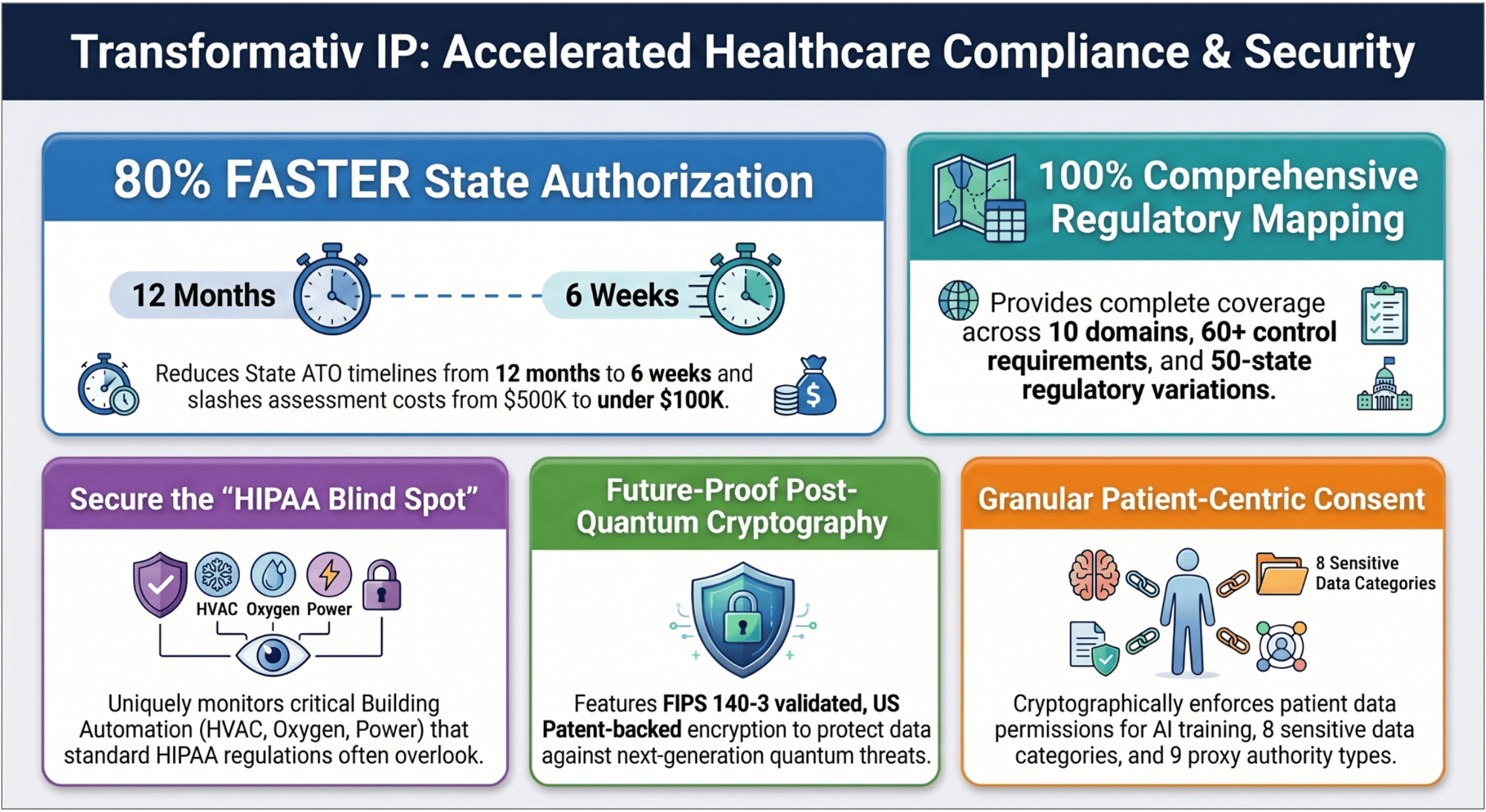
regulatory domains (CMS ATO, HIPAA, Cures Act/TEFCA, 42 CFR Part 2, FDA 524B, AI governance, OT/building automation, proxy authorization, PQC, 50-state laws)
federal control requirements
sensitive data categories (USCDI, SUD, behavioral health, reproductive health, HIV/AIDS, genetic, violence/abuse, SDOH)
AI consent use cases plus the Model Context Protocol server
building automation system types with 340+ protocol parsers
proxy authority types (POA, guardianship, attorney-client, criminal justice, educational, human services, housing, military, employment)
The states that move first will set the reciprocity standard for the other states.The states that wait, will be the ones the auditor uses for their case study.
Unique & Compelling RHTP Value: A CTO / CISO Perspective
RHTP Blueprint of Compliance — Slide Deck Video
RHTP Resources
Reference documents & audio briefings
Reference Documents
PQC+™ Technical Deep Dive for Hospital Leadership
Technical deep dive for hospital leadership · 23 pages
Audio Briefings
RHTP TransformativIP — The Master Key · 21 min
The integrated platform explained for technical leadership
RHTP TransformativIP — Analysis of Value · 55 min
Full economic, regulatory, and risk-reduction case
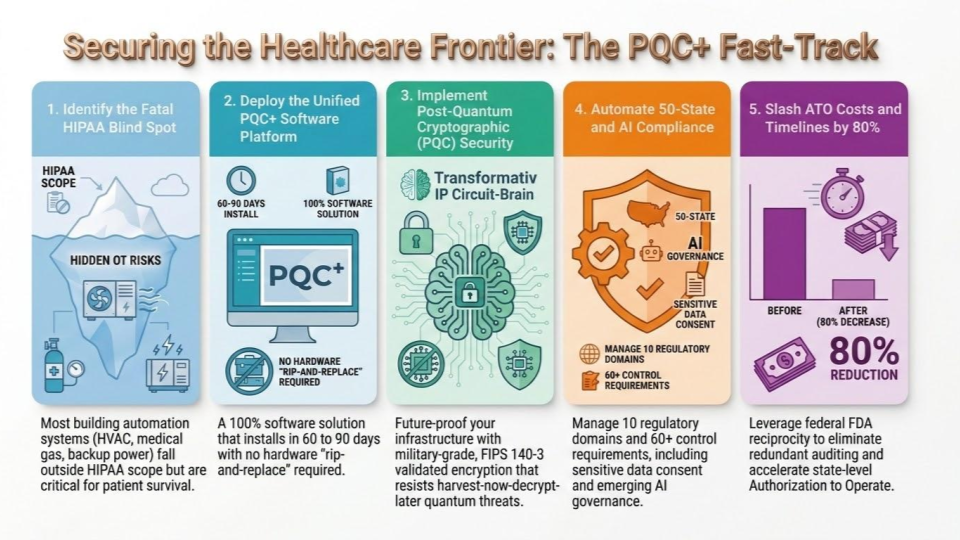
Compliant. Quantum-Safe. Federally Defensible. In 90 Days.
State leaders are often skeptical until they witness the FDA ATO and FIPS 140-3 certification first-hand. While competitors in the PQC space require years for deployment, we achieve results in just 3 months for a full installation.
- By leveraging a formal reciprocity package, we transfer our completed federal FDA Authorization to Operate compliance and cryptographic engineering directly to the state level.
- This transition transforms the independent state review from an exhaustive NIST 800-53 Moderate baseline into a focused delta assessment.
- Consequently, ATO expenses drop from the typical $300K–$500K range to between $50K–$100K, and the implementation schedule is accelerated from 6–12 months down to 6–8 weeks.
Days 1–30
Reciprocity Package + Gap Assessment
We deliver your State Medicaid Agency CISO a three-part reciprocity package: a Reciprocity Memorandum citing FISMA reciprocity under NIST SP 800-37, a full FDA ATO Scope Crosswalk, and a pre-populated Security & Privacy Plan (SSPP) drawn from the federal authorization. Your independent state review is reduced from a full NIST 800-53 Moderate baseline to a targeted delta. ATO cost falls from $300K–$500K to $50K–$100K. Timeline falls from 6–12 months to 6–8 weeks.
Days 30–60
Cryptographic + Consent Layer Deployment
We deploy Q-InfoSecur Module (FIPS 203/204/205, FIPS 140-3 validated) and TransformativIP Core Modules (consent, IP-ACL, FHIR R4, SMARTCompliance) into your RHTP environment. Two lines of code integrate with existing systems — no rip and replace, no EHR migration, no broken vendor contracts.
Days 60–90
OT Monitoring + AI Governance Live
PQC Monitoring goes live across building automation, medical devices, and AI agent traffic. The MCP server begins enforcing AI consent rules at the data layer. The continuous-monitoring evidence stream required for ongoing CMS authorization starts generating audit artifacts on day one of go-live.
Other vendors will still be writing your statement of work in month three. You will be operating under a defensible, audit-ready, quantum-safe RHTP environment.
The Fatal HIPAA Blind Spot — and Why Only PQC+™ Closes It
HIPAA was written for ePHI. It does not regulate the HVAC system that keeps your operating-room pressure differential safe. It does not regulate the medical gas distribution that keeps ventilated patients alive. It does not regulate the elevator priority systems that move stroke patients to the ED. Patients die when those systems fail. Auditors and plaintiffs' counsel now know this. Our PQC Monitoring component is the only platform on this list that closes that gap — across HVAC, medical gas, electrical power, pneumatic tube systems, elevators, fire and life safety, water management, and physical access control.
Building automation systems fall outside HIPAA scope, yet patient lives depend on them continuously. PQC Monitoring uniquely illuminates and secures this life-sustaining blind spot.
Built for the Rural Reality. Designed for the Federal Audit.
Rural networks are dispersed, low-bandwidth, equipment-heavy, and staff-light. PQC+™ was engineered for that environment from the first line of code.
01
CMS Compliance Automation
Automated documentation and reporting against NIST 800-53, CMS ARS, and the RHTP authorizing statute. Administrative burden reduced by up to 70%.
02
Post-Quantum PHI Protection
FIPS 203 (ML-KEM) and FIPS 204 (ML-DSA) across every PHI channel — public internet, satellite, cellular, telehealth. Closes the Harvest-Now-Decrypt-Later window before Q-Day 2029.
03
Telehealth Security
PQC-encrypted telehealth sessions with continuous session attestation. Built for variable rural bandwidth, not stripped down to fit it.
04
Connected Medical Device Security
Cryptographic gateway protection for legacy infusion pumps, patient monitors, and imaging equipment that cannot natively run modern encryption. Section 524B compliant on day one.
05
Rural Network Optimization
PQC algorithms are computationally heavier than classical. Our implementation is tuned for high-latency, variable-bandwidth rural links — full cryptographic strength, no performance penalty.
These Deadlines Are Already in Force. The First Federal Audit Cycle Is in 2026.
| Mandate | Requirement | Status |
|---|---|---|
| HIPAA Security Rule | Technical safeguards for ePHI, quantum-safe transition | Required by 2026 |
| CMS Interoperability Rule | FHIR API encryption standards | Active and audited |
| 21st Century Cures Act | Information blocking — penalty up to 25% reduction in total Medicare revenue | Active |
| Rural Health Strategy | Broadband security requirements | 2025 — already in force |
| NIST CSF 2.0 | Cryptographic controls update | 2025–2026 active migration |
| DOJ Data Security Program | Willful-violation criminal liability for officers | Effective January 1, 2026 |
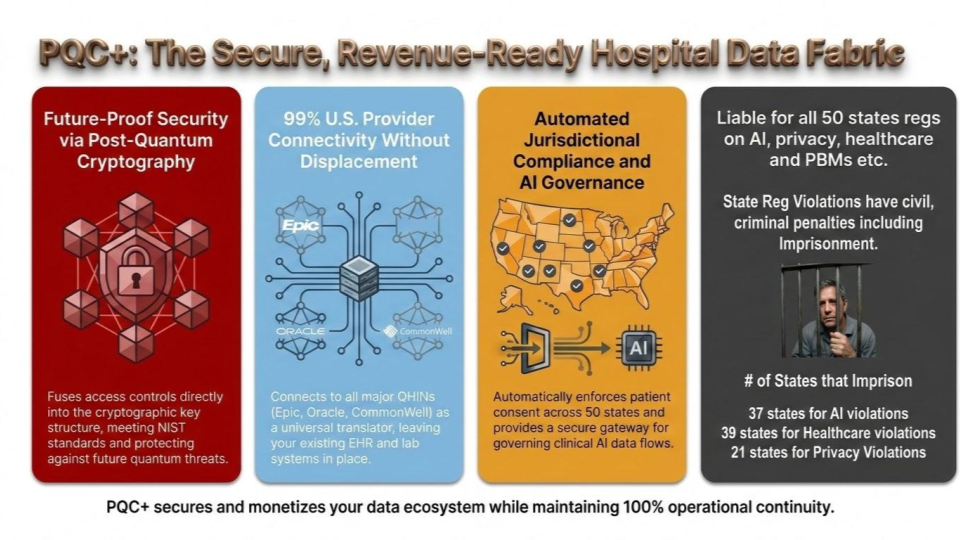
| State criminal statutes (39 healthcare / 37 AI / 21 privacy) | Personal liability for officers, including imprisonment in some states | Effective January 1, 2026 |
Your State Will Pay for the Software. You Will Face the Indictment.
The appointment that put you in the CTO, CISO, or CEO seat of your state's RHTP rollout came with a public-records trail. Every email, board minute, vendor evaluation, and decision memo is discoverable. When the federal audit finds a gap — and the first audit lands within twelve months — the question regulators will ask is not "did the state know?" It is "did you, personally, know?"
| The Briefing You Got | The Reality Since January 1, 2026 |
|---|---|
| "The state is the responsible entity." | The state is the payer. The individual officer is increasingly the named defendant under state criminal statutes. |
| "Our D&O policy will cover this." | D&O does not follow you into a criminal courtroom. It is also voidable on a finding of willful violation. |
| "We have a HIPAA program." | HIPAA covers ePHI. It does not cover the building automation, medical gas, power, and OT systems that patients' lives depend on — and where regulators are now looking. |
| "We'll do PQC after the rollout." | NIST FIPS 203/204/205 are the standard. CMS expects the migration plan now. "Later" reads as willful delay. |
| "Federal audits are about process." | The 2026 federal audit cycle ties findings directly to state funding eligibility under the RHTP authorizing statute. |
Post-Quantum Cryptography Without Regulatory Mapping Is a Liability, Not a Defense.
While approximately twelve PQC vendors currently offer credible solutions, we are uniquely positioned as the only provider to integrate our product with the audit and complex 50-state and federal regulatory compliance requirements required to pass RHTP audits. We are also 100% software and full installation of our PQC+ solution is within 90 days; whereas most competitors take years with expensive rip-and-replace requirements. Visit the PQC+ pages of our website.
Competitors typically provide data encryption and certification before concluding their engagement. However, a year from now, should another state's attorney general subpoena your audit trail regarding behavioral health data shared across state lines, encryption alone will prove insufficient. Without the necessary consent-management audit trail, which our competitors fail to provide, legal proceedings will continue regardless of your encryption status. If you visit our Regulatory Compliance page or DOJ DSP page, you will fully appreciate why we should be your top vendor.
| Capability | Typical PQC Vendor | TransformativIP PQC+™ |
|---|---|---|
| NIST FIPS 203/204/205 algorithms | ✓ | Vendor |
| FIPS 140-3 module validation | Sometimes | CVMP #4482 |
| Existing FDA Authorization to Operate | ✗ | Basis for state ATO reciprocity |
| Time to full deployment | 18 months – 3+ years | 60–90 days |
| CMS NIST 800-53 control mapping (60+ controls) | ✗ | ✓ |
| HIPAA Security Rule full coverage | Partial (technical safeguards only) | Incl. OT blind spot |
| 42 CFR Part 2 + 8 sensitive data categories | ✗ | Cryptographically enforced |
| 21st Century Cures Act / TEFCA / QHIN | ✗ | ✓ |
| FDA Section 524B medical device security | ✗ | ✓ |
| AI governance (5 consent use cases + MCP server) | ✗ | ✓ |
| OT/building automation (HVAC, medical gas, power, fire/life safety) | ✗ | 340+ protocol parsers |
| 9 proxy authority types (POA, guardianship, etc.) | ✗ | ✓ |
| 50-state regulatory variation engine | ✗ | SMARTCompliance |
| Reciprocity package for state ATO | ✗ | Cuts ATO from 6–12 months to 6–8 weeks |
Three Forces Just Collided. Most State Leadership Teams Have Connected None of Them.
We have briefed CTOs, CISOs, and CEOs across multiple awarded states. Most can name one of the three forces below. A handful can name two. We have not yet found a state leadership team that has connected all three — and the intersection of all three is exactly where RHTP audit findings, funding clawbacks, and personal criminal liability now live.
The Quantum Clock Is Real, and It's Federal
Google, IBM, and Microsoft — the companies actually building the machines — have converged on a 2029 "Q-Day" timeline. Google's Willow chip solved the underlying physics in December 2024; the remainder is engineering scale. NIST has already mandated post-quantum migration. CMS has the same expectation embedded in its 2025–2026 cryptographic controls update. Patient data flowing over your rural broadband today is being harvested today by adversaries who will decrypt it the moment the math breaks.
Rural Networks Are the Softest Target in the System
Patient data in rural networks moves over public internet, satellite links, and consumer-grade cellular — all of it interceptable. A single Critical Access Hospital may serve patients across multiple counties with no centralized security perimeter. CMS mandates apply to those facilities at exactly the same standard as Mayo Clinic. The funding gap between them is not relevant to the auditor.
The Liability Is Now Personal, and Jurisdiction Follows the Patient
Under the DOJ Data Security Program effective January 2026, when a leader was aware of a known threat and failed to act, the legal designation shifts from negligence to "willful violation." Worse for state RHTP officials: jurisdiction is determined by where the patient lives, not where you sit. A rural patient treated across state lines pulls you into that patient's state criminal code — even if you've never set foot there.
"Wait and see" is no longer an analytical posture. For a state RHTP official, it is a documented decision that prosecutors and plaintiffs' attorneys will read into a transcript on day one of an audit.
Start the 90-Day Clock.
The first state to deploy sets the federal reciprocity precedent. Your free RHTP Compliance Assessment delivers a written gap analysis against all 10 regulatory domains, 60+ controls, and your specific state's criminal-liability statutes — in under two weeks, at no cost, with no obligation.
NIST FIPS 203/204/205 · FDA Authorization to Operate · DoD IL5