Your AI Infrastructure Has a New Attack Surface
The Model Context Protocol (MCP) enables powerful AI integrations — and creates critical new security vulnerabilities. Without cryptographic controls, your enterprise AI systems are exposed to novel, high-impact attacks.
Anthropic MCP AI Narrated Slide Deck
AI Regulatory Landscape and Defensible Architecture
Research & Documentation
What Is MCP?
The Model Context Protocol (MCP) is an open standard that enables AI systems (like Claude, GPT-4, and enterprise AI agents) to connect to external data sources, tools, and services. An AI with MCP can access files, query databases, call APIs, browse the web, and execute code — all autonomously.
This capability is transformative — and dangerous. When an AI agent can take actions in the world on behalf of your enterprise, every MCP connection becomes a potential attack vector. Adversaries who control even a single MCP data source can influence every decision the AI makes.
Unlike traditional software vulnerabilities, MCP attacks exploit the AI's reasoning process itself — making them invisible to traditional security tools designed to detect code execution anomalies or network intrusions.
Why This Is Different
MCP Attack Vectors
Prompt Injection via MCP
CRITICALMalicious data sources connected via MCP can inject adversarial prompts that override AI system instructions, causing models to exfiltrate data, execute unauthorized actions, or provide false outputs.
Tool Poisoning
CRITICALMCP servers exposing tools (file access, API calls, database queries) can be compromised to return malicious data that manipulates AI decision-making and triggers unintended privileged actions.
Context Window Manipulation
HIGHAttackers who control any MCP data source can inject content into an AI agent's context window — causing it to leak confidential information or take actions outside its authorized scope.
Supply Chain Attacks on MCP Servers
HIGHThird-party MCP servers and plugins can contain malicious code. Without cryptographic verification of server integrity, enterprises cannot trust the tools their AI systems use.
Data Exfiltration via AI Outputs
HIGHAI agents with MCP tool access to internal systems can be manipulated into encoding sensitive data within benign-looking outputs, bypassing traditional DLP controls.
TransformativIP MCP Defense
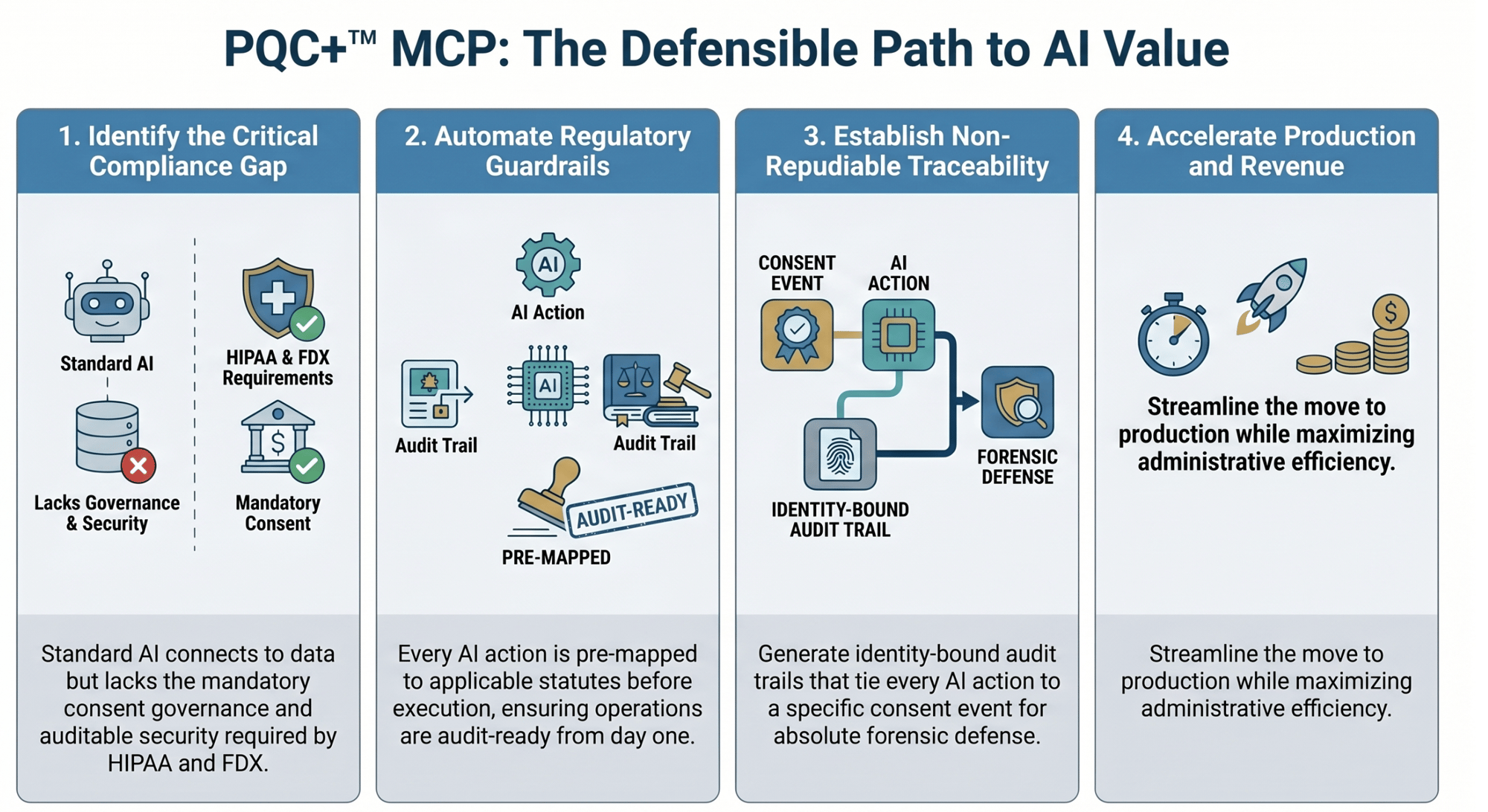
Cryptographic MCP Server Attestation
Every MCP server and tool connection is cryptographically verified using PQC-grade signatures. Unattested servers are blocked before they can inject data.
Input/Output Sanitization
All MCP data flowing into AI context windows is inspected and sanitized using ML-based injection detection. Prompt injection patterns are blocked in real time.
Privilege Separation Layer
AI agents operate in cryptographically enforced privilege zones. Tool calls are scoped to the minimum permissions required, with quantum-safe audit trails for every action.
Anomaly Detection
Behavioral monitoring detects when AI agents deviate from their intended behavior patterns — catching compromised AI workflows before data is exfiltrated.
Secure Your AI Infrastructure
Get an MCP security assessment before your enterprise AI systems become a liability.