MDM Defense: Business Case for Leadership
A concise executive briefing on the mobile and physical security threats facing mid-tier enterprises in the USA, Canada, Mexico, South America, Asia, Europe and the Persian Gulf, and the business case for post-quantum MDM Defense.
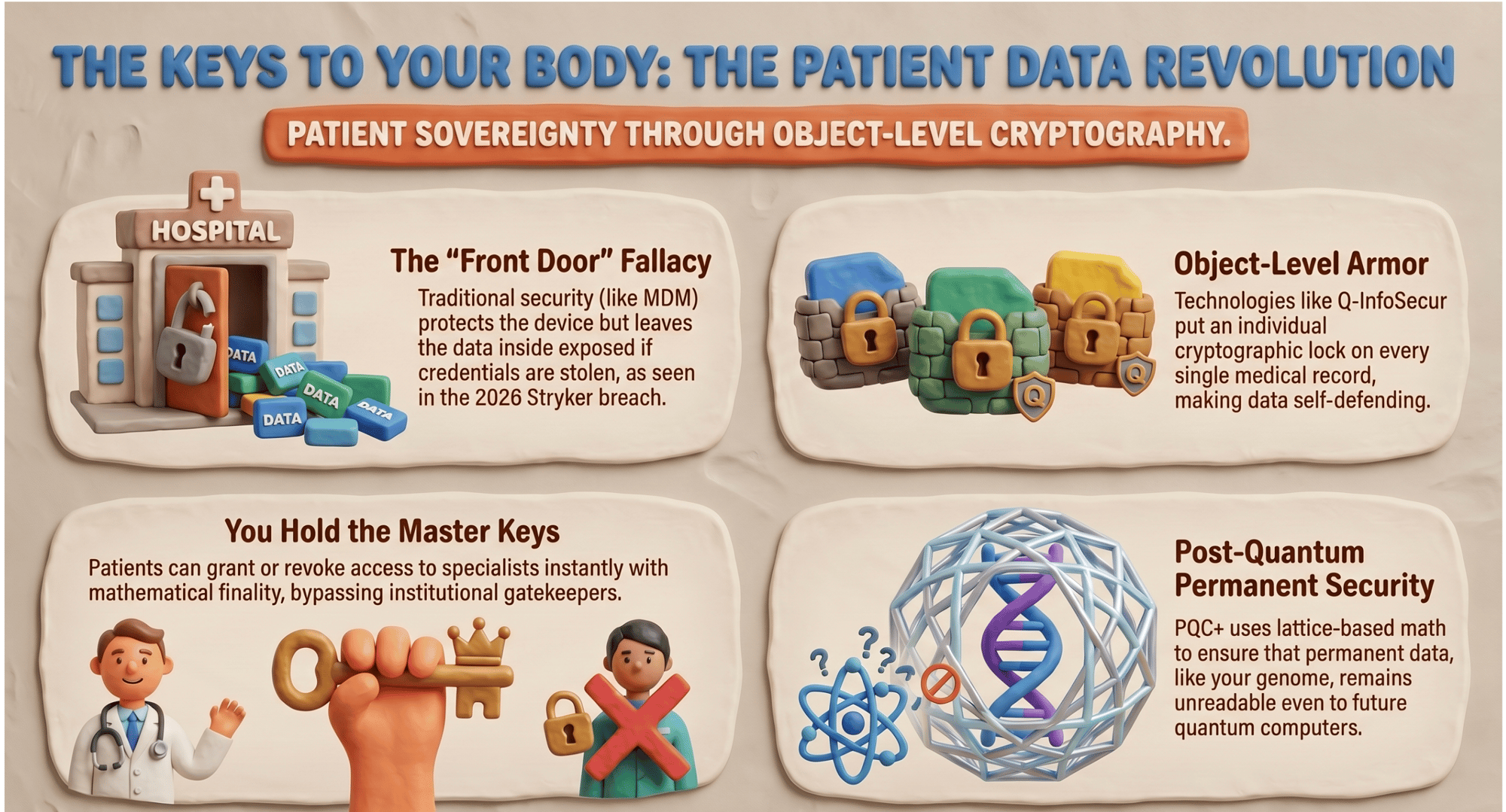
How We Prevent a Stryker-like CyberAttack
How We Build a Stryker Hack Proof Defense
Technical Documents
MDM Defense Executive Summary (PDF)
Full executive briefing document — ready for board and C-suite presentation.
The Business Problem
Enterprise mobile endpoints represent the fastest-growing attack surface in corporate security. The average enterprise has 3–5 mobile devices per employee, yet mobile MDM budgets represent less than 8% of security spending. This asymmetry creates a critical vulnerability that adversaries are actively exploiting.
The emergence of affordable commercial drones — capable of intercepting WiFi, Bluetooth, and cellular signals — has extended the attack surface beyond the corporate network perimeter into physical space. Facilities that were once physically secure are now exposed to airborne surveillance and interception.
Simultaneously, the approaching Q-Day deadline means that classical MDM encryption solutions provide only short-term protection. Organizations that do not migrate to post-quantum MDM before 2029 will find their device communications retroactively compromised via HNDL attacks.
The Solution
TransformativIP MDM Defense deploys as an overlay on existing MDM infrastructure (Jamf, Microsoft Intune, VMware Workspace ONE) — adding post-quantum encryption and drone detection without replacing existing tools or workflows.
The ROI Case
Architecture Overview
- System architecture and component diagram
- PQC cryptographic layer design
- Integration with existing MDM platforms
- Network topology requirements
- High availability and failover design
Cryptographic Specifications
- ML-KEM (FIPS 203) key encapsulation implementation
- ML-DSA (FIPS 204) digital signature scheme
- Hybrid classical/PQC transition mode
- Key management and rotation policies
- Certificate authority integration
MDM Platform Integration
- Microsoft Intune integration guide
- Jamf Pro integration guide
- VMware Workspace ONE integration
- Custom MDM API documentation
- iOS and Android PQC agent deployment
Drone Detection System
- RF signature analysis methodology
- Drone classification algorithms
- Alert escalation and response playbooks
- Hardware sensor requirements and placement
- Legal considerations for drone neutralization
Compliance & Audit
- Automated compliance evidence generation
- NIST FIPS conformance documentation
- HIPAA/GLBA technical safeguard mapping
- DOJ-DSP cryptographic control documentation
- Audit log format and retention requirements
Performance & Scalability
- Cryptographic operation benchmarks
- Latency impact analysis
- Enterprise scale deployment (10K+ devices)
- Edge deployment for low-bandwidth environments
- Performance tuning guide
Quick Technical Reference
| Component | Standard | Algorithm | Security Level |
|---|---|---|---|
| Key Encapsulation | FIPS 203 | ML-KEM-768 | NIST Level 3 (AES-192) |
| Digital Signatures | FIPS 204 | ML-DSA-65 | NIST Level 3 |
| Hash-Based Signatures | FIPS 205 | SLH-DSA-128s | NIST Level 1 |
| TLS Transport | RFC 8446 + PQC | Hybrid TLS 1.3 + ML-KEM | Classical + PQC |
| Device Attestation | FIPS 204 | ML-DSA-44 | NIST Level 2 |