DOJ-DSP: Data Transfers to Adversaries Are a Crime
The Department of Justice Data Security Program imposes criminal penalties on US persons and companies that transfer covered data to adversarial nations — intentionally or inadvertently.
Effective April 2025: DOJ-DSP enforcement is active. Violations carry $1M+ fines and up to 20 years imprisonment per violation.
The Five Titles in the DOJ's Crosshairs
The Department of Justice's enforcement priorities have moved past the corporation and onto the individual. The willful violation standard is designed to reach decisions made at the executive level — but the specific exposure depends entirely on the title on your business card. This briefing breaks down what each C-suite role actually risks, why "I delegated it" no longer works, and what a defensible posture looks like under current enforcement patterns.
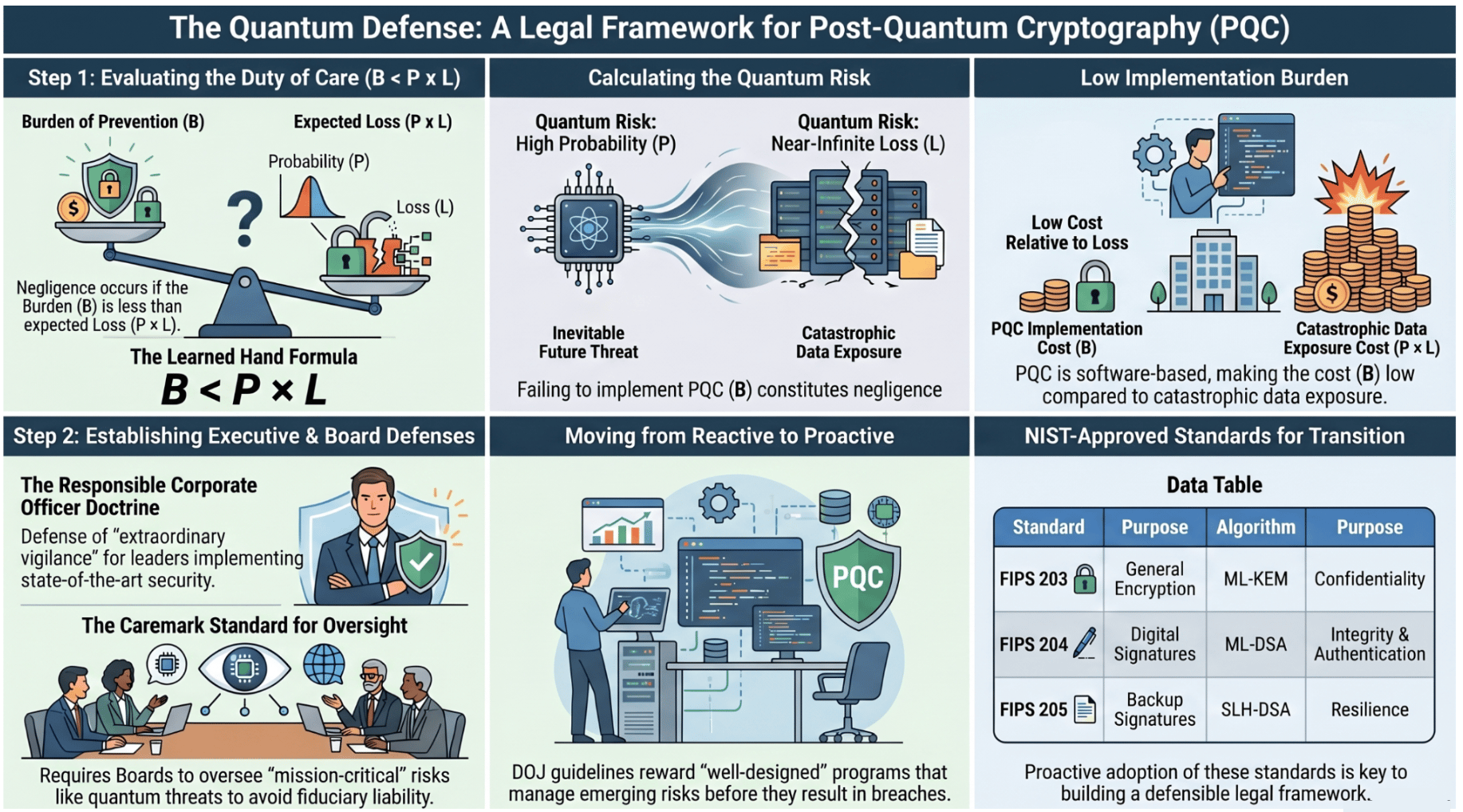
DOJ Prosecutor Formula for Regulatory Negligence
Optimal Strategy to Mitigate DOJ DSP Prosecution Risks
Regulatory Analysis: How PQC+™ Minimizes DOJ DSP Liability
DOJ DSP liability analysis · 7 pages
What Is the DOJ-DSP?
Issued under Executive Order 14117 and codified in 28 CFR Part 202, the DOJ Data Security Program is a national security regulation that restricts US persons and companies from transferring "covered data" — sensitive personal information about US citizens — to countries of concern.
Unlike HIPAA or GDPR, DOJ-DSP is a national security statute enforced by the National Security Division of the DOJ. There are no cure periods, no warning letters, and no administrative exhaustion requirements. Violations go straight to criminal grand jury investigation.
The rule became effective April 8, 2025, with full enforcement beginning immediately. The DOJ has stated it will pursue both corporate and individual criminal liability for willful violations.
Countries of Concern
What Data Is Covered?
Common Violation Scenarios
Cloud Service Provider
Using a cloud provider that routes or stores covered data through data centers in restricted countries — even if the provider is a US company — may constitute a prohibited data transfer.
Offshore Development Teams
Development or IT teams in restricted countries with access to covered US person data triggers DOJ-DSP restrictions. Access controls and architectural separation are required.
AI Training Data
Sending covered personal data to AI platforms, training pipelines, or analytics services with adversarial-country ownership or control falls within DOJ-DSP scope.
M&A Data Rooms
Sharing covered data in virtual data rooms accessible to adversarial-country investors or acquirers requires DOJ review and potentially CFIUS filings.
TransformativIP PQC+™ — DOJ-DSP Compliance
Our platform provides the cryptographic controls, data residency enforcement, and audit trails required for DOJ-DSP compliance — including real-time monitoring for unauthorized data egress to restricted jurisdictions.
Data Residency Control
Enforce geographic boundaries on all covered data at the cryptographic layer
Access Monitoring
Real-time alerts when restricted-country IPs or entities attempt data access
Audit Evidence
Automated compliance documentation for DOJ-DSP due diligence defense