The Day Encryption Dies
Q-Day is the moment a quantum computer becomes powerful enough to shatter today's encryption in hours. RSA, ECC, and every TLS session protecting your enterprise will be retroactively vulnerable — including data already stolen and waiting.
NIST, NSA, and CISA have all issued warnings: enterprises that are not PQC-ready before Q-Day will face catastrophic data exposure.
Q-Day the Ultimate Regulatory Compliance Nightmare
Your Q-day & C-Suite Regulatory Compliance Problem
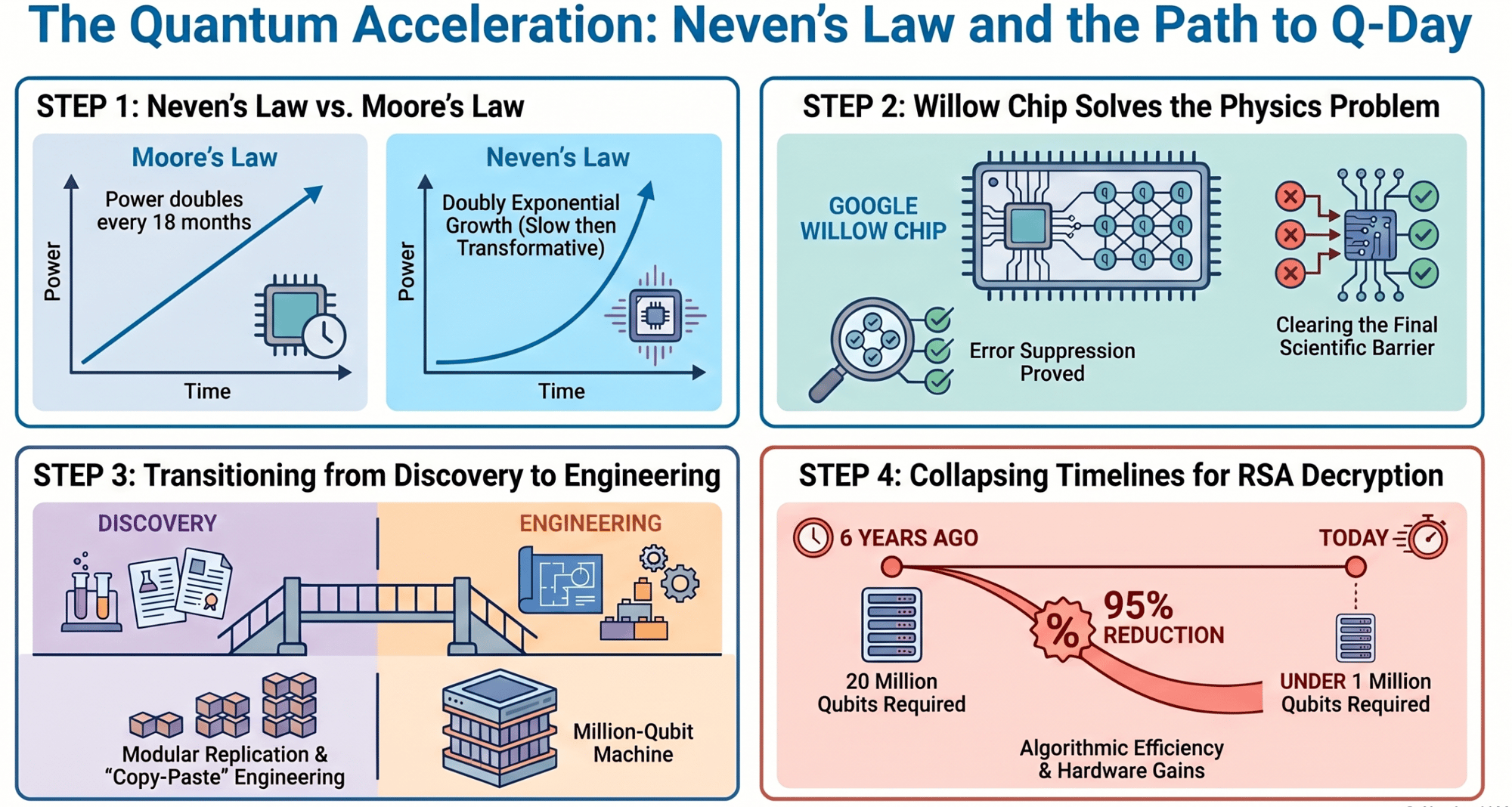
Google Quantum AI Lab Founder on Q-Day Arriving Sooner
Analysis by Google Quantum AI Lab founder Dr. Hartmut Neven · 7 pages
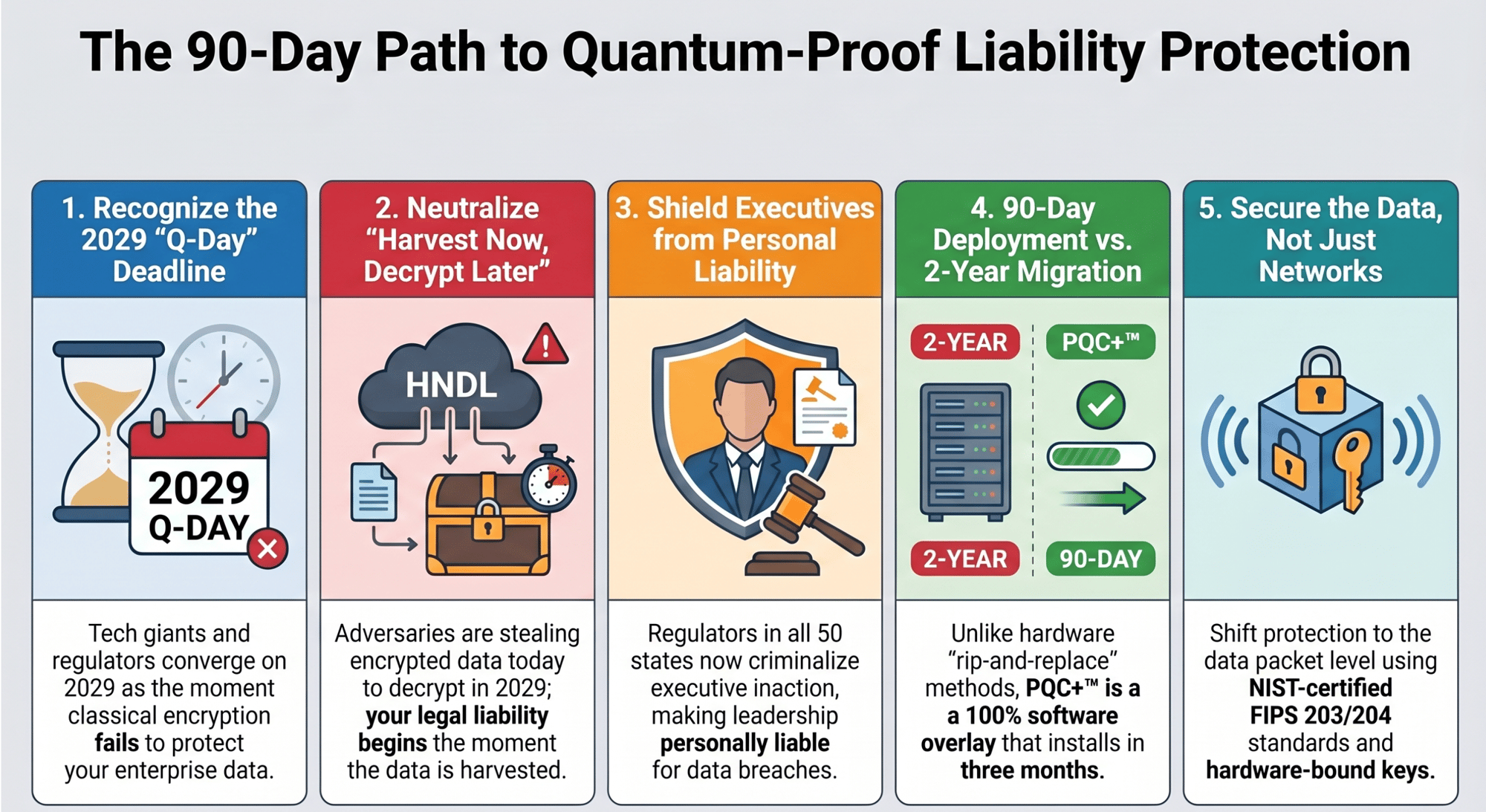
The Mother of All Regulatory Nightmares
PQC+™ executive briefing — Q-Day, HNDL, and the 90-day path to quantum-proof liability protection
What Is Q-Day?
Q-Day refers to the point in time when a quantum computer becomes powerful enough to break the public-key cryptography protecting virtually all internet traffic, financial systems, and enterprise data. The name derives from "quantum" — the day quantum supremacy ends the era of classical encryption.
Today's encryption — RSA, Elliptic Curve Cryptography (ECC), and Diffie-Hellman key exchange — relies on mathematical problems that classical computers cannot solve in practical time. A sufficiently powerful quantum computer running Shor's Algorithm can solve these problems in hours or minutes.
When Q-Day arrives, every piece of data ever encrypted with classical algorithms becomes readable — including data that adversaries harvested years earlier in anticipation of this exact moment. This is why Q-Day is not a future problem. It is a present emergency.
What breaks on Q-Day
- ✕TLS / HTTPS — every web and API session
- ✕RSA-2048 / RSA-4096 encryption
- ✕Elliptic Curve Cryptography (ECDH, ECDSA)
- ✕Digital signatures on contracts and code
- ✕VPN tunnels and IPsec communications
- ✕SSH keys and certificate authorities
- ✕Blockchain signatures (Bitcoin, Ethereum)
- ✕S/MIME and PGP email encryption
The Q-Day Timeline
NIST calls for post-quantum cryptography submissions after recognizing quantum threat horizon.
ML-KEM (Kyber), ML-DSA (Dilithium), and SLH-DSA (SPHINCS+) selected as the new standard.
NIST publishes final PQC standards. Federal agencies required to begin migration planning.
Organizations must complete cryptographic inventories and begin PQC deployment to beat Q-Day.
IBM, Google, and CISA projections converge on late 2020s for cryptographically relevant quantum computers.
RSA, ECC, and Diffie-Hellman are broken. Only organizations already running PQC are protected. However, as a result of HNDL those who did not implement PQC, if hacked by what the FBI and NSA consider over $500 Billion in annual IP theft from China alone, are at serious personal risk of being charged criminally under a lengthy list of state regulations across 50 states and for federal regulations as well. If their organization had implemented PQC+™ then the regulatory compliance problem across 50 states, the HNDL problem and PQC implementation would have been paid for by their organization. Delaying increases the probability they will pay a large personal cost that, if you look at the Regulatory Compliance page of this website, the penalties will be paid by the CEO, CTO, CISO, General Counsel or BOD personally.
Sector-by-Sector Impact
Financial Services
Every TLS-protected transaction, wire transfer, and inter-bank communication becomes retroactively readable. Digital signatures on contracts and trades are forgeable.
Healthcare
Patient records encrypted under RSA or ECC are exposed. HIPAA-covered entities face catastrophic breach liability for data harvested years before Q-Day arrives.
Government & Defense
Classified communications, personnel files, and procurement data harvested today become readable instantly on Q-Day. National security implications are severe.
Energy & Infrastructure
SCADA and industrial control system communications rely on classical crypto. Q-Day enables adversaries to replay captured commands and forge control signals.
Why You Cannot Wait
Migration Takes Years
Replacing cryptographic infrastructure across an enterprise — applications, APIs, certificates, key stores — takes 2–4 years on average. You cannot start on Q-Day.
HNDL Attacks Are Already Active
Nation-state actors are harvesting your encrypted data right now. The clock started without you. Every day of delay extends your retroactive exposure window.
Regulatory Deadlines Are Set
CISA, NSA, and OMB have issued directives requiring federal agencies and contractors to be PQC-ready by 2035 — with interim milestones beginning 2027.
Certification Takes 18+ Months
Achieving FIPS-validated PQC compliance requires an average of 1.59 years. Procurement and testing cycles add further delay.
Your Migration Window Is Open — For Now
TransformativIP PQC+™ implements NIST-finalized post-quantum algorithms today, with hybrid mode for zero-disruption migration. Every day you wait narrows the window between compliance and catastrophe.