The Mother of All Regulatory Nightmares Just Became Personal: Post-Quantum Cryptography and Executive Liability
The Breach Window Did Not Start When the Quantum Computer Is Turned On. It Started Years Ago.
Here is the calculus that should reframe every cybersecurity budget conversation you have in 2026.
If your enterprise needs X years to migrate, and your data must remain confidential for Y years, then you are exposed any time a quantum computer arrives in fewer than X + Y years.
Apply that math to a regional hospital system or a mid-tier bank. Patient records, genomic data, M&A files, and personnel records routinely carry 30- to 50-year confidentiality requirements. Even a 3-year migration window means your current cryptography has to hold for 33 to 53 years. Against a quantum capability arriving in 2029, the records you encrypted last Tuesday are already on borrowed time.
The question is no longer whether to move. It is whether you move in time.
Featured Videos
Watch: PQC+™ Overview
PQC+™ The Trap of Personal Liability Explained
PQC+™ Solves Very Serious Problems in 90 days
Reference Articles
Download: PQC+™ Briefing Documents
Detailed written briefings covering HNDL, regulatory liability, and the PQC+™ solution — formatted for sharing with your board, legal counsel, and executive team.
9 pages · Executive & legal briefing on personal liability and the PQC+™ good-faith defense
Audio Briefings
Listen: PQC+™ Executive Podcasts
Each episode covers the same essential reality from a different angle — HNDL, 50-state regulatory liability, federal exposure, and the 90-day no-rip-and-replace path to full compliance. Start with any episode.
90 sec · Fast-track overview of PQC+™ and what it solves
22 min · Post-quantum cryptography, HNDL, 50-state liability, 90-day deployment
41 min · Full briefing: HNDL, federal & 50-state liability, 90-day deployment, free trial
The Changed Regulatory & Quantum‑Risk Environment
Our, Q-InfoSecur™, provides quantum-resistant security using CNSA-compliant algorithms executed within a FIPS 140-3 Validated cryptographic module.
Six pillars of dispute-proof evidence from U.S. government primary sources — the authorities procurement officers and boards recognize instantly. Click any card to expand its verified sources and supporting evidence.
State Privacy Laws & Enforcement
DOJ Data Security Program
Post-Quantum Migration & HNDL
Executive & CISO Personal Liability
PBM Scrutiny — Federal & State
State AI Laws Proliferating
Why These Sources Are Dispute-Proof
U.S. government primary sources (DOJ, CISA, NSA, NIST, Federal Register) are authoritative, easily verifiable by procurement officers, and — as U.S. federal government works — cannot be dismissed as vendor marketing. These are the strongest possible foundation for any regulatory or security claim. View the full Evidence Wall →
Three Things Have Changed. Most Boards Have Connected None of Them.
Most executives we brief on this can name one of the three forces below. A small minority can name two. We have not yet met a CTO, CISO, or CEO outside of the federal regulatory community who can name all three — and the intersection of all three is where personal criminal liability now lives.
Force 1
The Builders Have Spoken
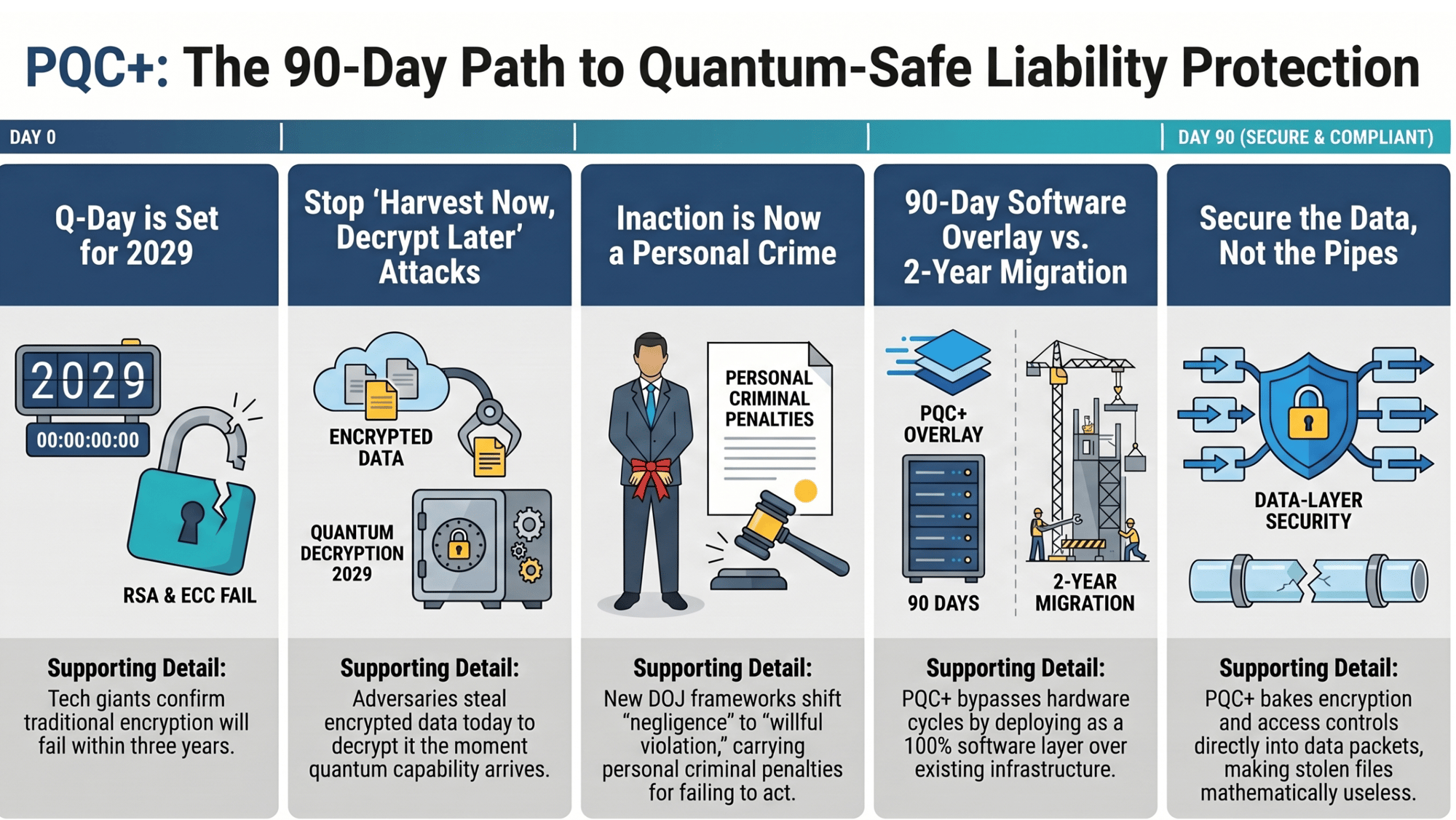
Google, IBM, and Microsoft — the companies actually building quantum computers — have publicly converged on a 2029 "Q-Day" timeline: the moment classical RSA and ECC encryption stop protecting your data. Google's Willow chip solved the underlying physics in December 2024. The remaining work is engineering scale.
Force 2
The Breach Is Already Happening
Nation-state actors and organized cybercriminals are running "Harvest Now, Decrypt Later" operations at scale right now — vacuuming up RSA- and ECC-encrypted traffic and storing it against the day the math breaks. The data your adversary will decrypt in 2029 was stolen this quarter.
Force 3
The Liability Is Now Personal
Under the DOJ Data Security Program effective January 2026, when leadership was aware of an emerging threat and failed to act, the legal designation shifts from negligence to "willful violation." Jurisdiction is determined not by your headquarters — but by where your patients or clients live.
“Wait and see” is no longer an analytical posture. It is a documented decision that prosecutors and plaintiffs' attorneys will read into a transcript.
Your Institution Will Pay for the Software. It Will Not Pay for Your Criminal Defense.
This is the part of the briefing that most CTOs and CISOs find genuinely uncomfortable, and that most CEOs have not yet been briefed on by counsel. The 2026 regulatory environment did not just raise the stakes. It moved the consequences from the corporate balance sheet to the individual executive.
Our own polling indicates that fewer than 10% of executives are aware of the personal exposure they currently carry. The gap between those two numbers — what is true and what is known — is the entire reason this page exists.
Healthcare, AI, and Privacy Are Now One Problem. Most Compliance Teams Are Still Organized as Three.
Most enterprises still treat healthcare compliance, AI governance, and privacy law as separate problems run by separate teams. They are not. They are converging at the level of the data itself — and they are converging into a single, indivisible obligation that no policy layer or perimeter layer can satisfy.
criminal-penalty states
Healthcare
HIPAA is the federal floor. State law is the ceiling, and the ceiling now includes imprisonment in 39 states. Mid-tier hospitals, regional health systems, PBMs, telehealth platforms, and connected medical devices face overlapping and sometimes conflicting state mandates.
criminal-penalty states
AI Governance
AI regulation arrived faster than almost any compliance team forecast. Colorado, California, New York, Texas, and 33 other states have imposed obligations on automated decision-making systems — many with criminal penalties for negligent deployment, undisclosed model use, or biased outcomes.
criminal-penalty states
Privacy
Twenty-one states now criminalize specific categories of privacy violations: unauthorized disclosure of biometric data, sale of sensitive personal information without consent, and willful failure to honor consumer rights requests. The patchwork is no longer manageable through policy alone.
The implication for leadership: Compliance can no longer be enforced at the policy layer or the perimeter layer. It must be enforced at the data layer itself — because that is the only layer that travels with the obligation.
Every PQC Vendor Says “FIPS 203 and 204.” That's Table Stakes. Here's What Separates PQC+™ from the Rest of the Market.
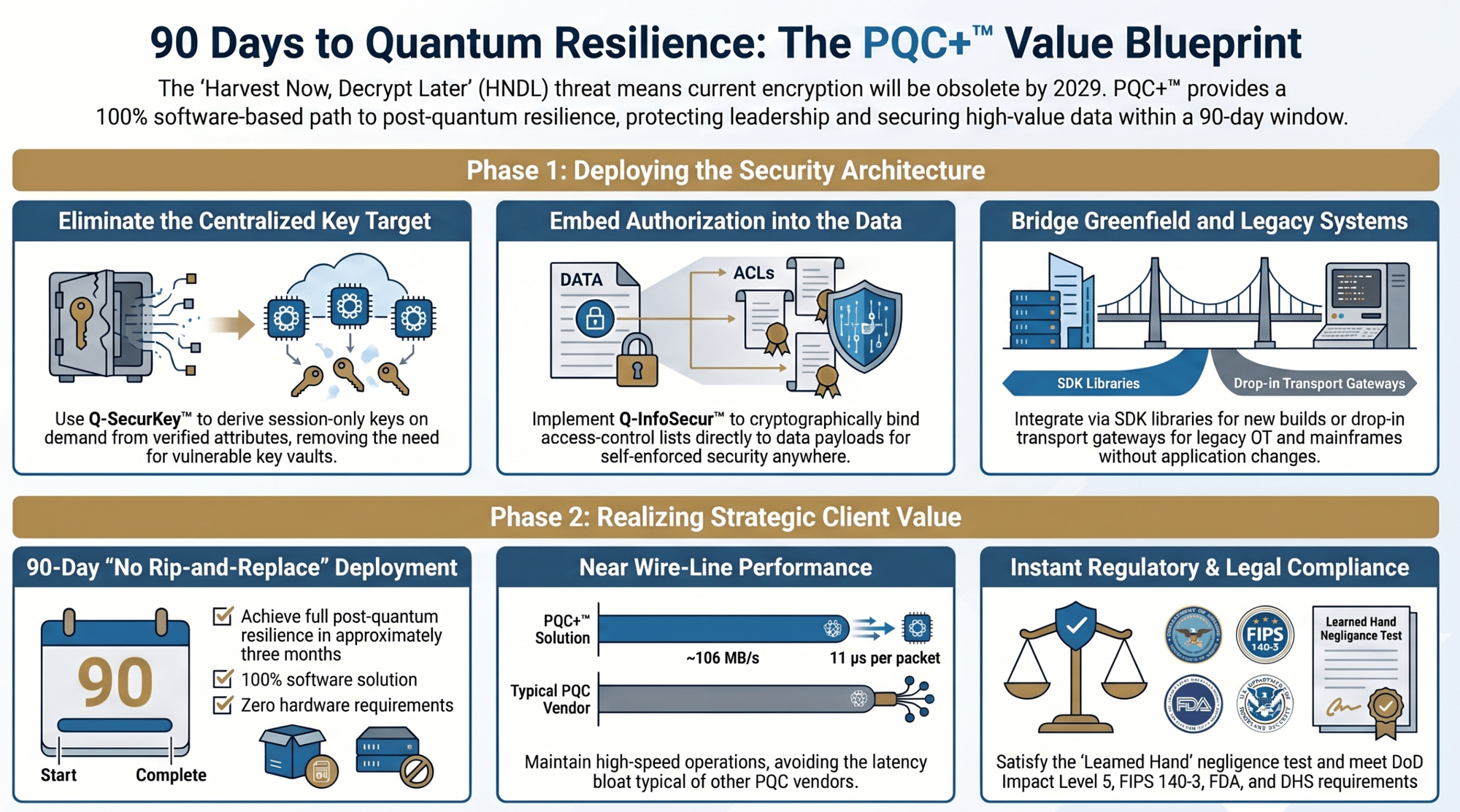
The other PQC vendors are not wrong. They are slow. The industry-standard PQC migration timeline assumes rip-and-replace: new hardware security modules, new endpoint agents, new key management infrastructure, a procurement cycle measured in fiscal years, and per-application integration work that typically runs 18 to 36 months. By the time most of those projects finish, the data harvested today has already been decrypted.
This matters more than it sounds: every day between today and your migration completion is a day on which an adversary may be harvesting data that will be readable in 2029. The math of “Harvest Now, Decrypt Later” does not care whether your CFO has approved the budget yet.
Protection Moves Out of the Perimeter and Into the Data Itself.
Most security tools defend the pipes — the networks. PQC+™ secures the water — the data itself. Every piece of regulated information you hold — a patient record, a financial transaction, an AI model output, a consent attestation — carries its own cryptographic envelope. Inside that envelope is everything a regulator, a prosecutor, or an adversary would need to ask about.
01. ENCRYPTION
Certified Post-Quantum Encryption
FIPS 203 (ML-KEM) and FIPS 204 (ML-DSA) — the NIST-finalized post-quantum standards. PQC+™ is the only post-quantum-strength software we know of that simultaneously carries DoD Impact Level 5, FIPS 140-3, FDA, and DHS approvals.
02. ACCESS CONTROL
Embedded Identity & Privacy ACLs
Access controls are baked into the encrypted payload itself. Authorization is enforced at the moment of access, on the specific authorized hardware, under the specific authorized conditions — not at the moment of provisioning. The data enforces its own rules wherever it travels.
03. CONSENT
Dynamic Consent Attributes
HIPAA, GDPR, state privacy law, and AI training-consent obligations are enforced by the data itself, not by a downstream system that may or may not honor them. If a patient revokes consent, the next access attempt fails — everywhere the data exists, with no central re-encryption project required.
04. KEY MANAGEMENT
Hardware-Bound Keys
A stolen password is mathematically useless without the specific authorized device. A stolen database becomes millions of individual quantum-locked files with no resale value on the dark web. The economic model that has driven 20 years of data breaches collapses.
Tiered Key Strength for the Data You Actually Have
In practical terms: when a regulator or a prosecutor asks whether your enterprise prevented unauthorized access — not whether you intended to, not whether you had a policy that said you would, but whether you mathematically prevented it — PQC+™ produces a cryptographic record that answers the question.
Why a Documented PQC+™ Deployment Is the Single Most Powerful Evidence in Your Favor.
The DOJ Data Security Program framework is explicit on both sides of the ledger. On one side: when leadership was aware of an emerging threat and failed to act, the designation shifts from negligence to willful violation. On the other side: implementing NIST-certified post-quantum cryptography is treated as a good-faith compliance measure. It does not guarantee immunity. It does fundamentally change how regulators and prosecutors evaluate culpability after an incident — especially criminal culpability and the imprisonment that follows.
The analogy executives understand intuitively is fire suppression.
Two companies suffer a fire. One installed a certified suppression system before the incident; the other did not. They face very different questions about accountability — even when the outcome of the fire is the same.
WITHOUT a documented PQC deployment:
- ✕"Willful violation" designation becomes available to prosecutors
- ✕Defense costs typically exceed $1M per DOJ charge
- ✕D&O clawback activates on conviction or plea
- ✕Personal criminal exposure: up to 20 years federal, up to 50 years state
- ✕Civil penalties assessed against individual officers
WITH a documented PQC+™ deployment before the incident:
- ✓Willful violation theory is substantially harder to sustain
- ✓Good-faith remediation drops penalties at sentencing
- ✓Documented dated artifact lives in your compliance file
- ✓Personal exposure reduced; corporate exposure reduced
- ✓The single most powerful evidence the defense can present
The question prosecutors and plaintiffs' attorneys are now asking is narrow and answerable:
“Did the executive deploy commercially available, NIST-certified post-quantum cryptography when it became available?”
“We were evaluating it” is no longer a defensible answer when a 90-day deployment path exists.
Three Actions, In This Order.
Document what you did before the breach.
The personal liability framework is retrospective. Prosecutors will look at what you knew, when you knew it, and what you did about it. The single most powerful evidence in your favor is a documented, dated record of evaluation and deployment of NIST-certified post-quantum cryptography. That record exists, or it doesn't. There is no third option.
Treat the 50-state patchwork as a single problem.
PQC+™ is engineered to satisfy the strictest jurisdiction by default — including foreign-headquartered entities operating in or selling into U.S. markets. Compliance with the strictest regime produces compliance with the rest, including the criminal-penalty regimes in the 39, 37, and 21 states cited above.
Use the free trial to establish institutional knowledge.
PQC+™ offers free trialware. This is not a procurement tactic — it is a governance tactic. A documented evaluation, conducted in advance of a board meeting or an audit, is precisely the diligence that distinguishes a defensible executive from a personally liable one. It costs nothing. It produces a dated artifact that lives in your compliance file. It can begin today.
The Regulatory Environment Has Criminalized Inaction. The Cryptographic Environment Has Shortened the Half-Life of “Good Enough.”
PQC+™ is the only path we are aware of that closes both gaps in 90 days, on certified standards, with a documented trail that protects both the enterprise and the individuals who lead it.
The organization that starts its PQC+™ migration in 2026 will complete it before the end of the next quarter — well before 2029. The organization that waits for 2028 will be migrating under emergency conditions, at emergency costs, with emergency consequences.
Every day of delay is a day of harvested data, of accumulated regulatory exposure, and of personal liability that compounds — not from what you did, but from what you did not do in time.
Your institution may pay for the PQC+™ deployment. It will not pay for your criminal defense. Start the 90-day clock today.