The New Jurisprudence of Clinical Information
Healthcare data law is undergoing a fundamental transformation — from HIPAA baselines to a 50-state patchwork of AI liability, patient sovereignty mandates, and post-quantum cryptography requirements. Here is what every attorney advising healthcare and enterprise clients must know.
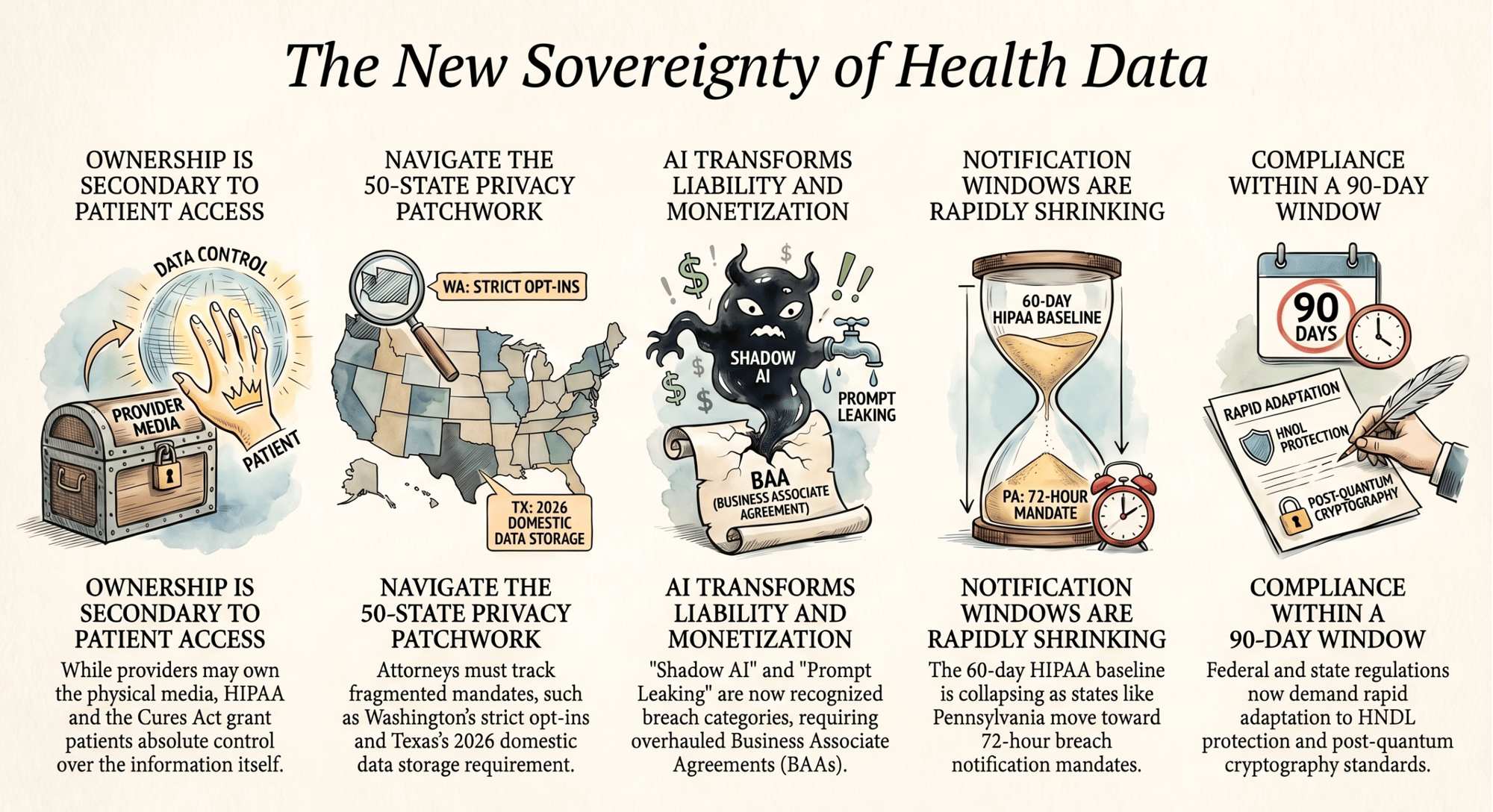
HIPAA & Cures Act grant patients absolute control over their health data, overriding provider ownership of physical records.
Washington, Texas, California, and 47 other state regimes create fragmented mandates attorneys must track jurisdiction-by-jurisdiction.
"Shadow AI" and "Prompt Leaking" are now recognized breach categories, requiring overhauled Business Associate Agreements.
Federal and state regulations demand rapid adaptation to HNDL protection and post-quantum cryptography — notification windows are shrinking fast.
The Jurisprudence of Clinical Information
The Jurisprudence of Clinical Information
Overview Podcast
Healthcare Data Ownership and AI Liability — 21 min

A 21-minute overview of healthcare data ownership rights, patient sovereignty mandates, AI liability exposure for providers, and the legal obligations attorneys must advise clients on under the expanding 50-state patchwork.
State-Level Variations Attorneys Must Track
- ›Requires medical data stored domestically within the U.S.
- ›Mandates AI diagnosis disclosure to patients
- ›Domestic data storage requirement effective 2026
- ›Patients may sue for negligent data breaches
- ›5-day patient data access mandate (vs. 30-day federal baseline)
- ›CCPA extends to health app data and AI-derived inferences
- ›My Health MY Data Act covers consumer health apps
- ›Prohibits location tracking near clinics without consent
- ›Requires explicit opt-in, not just opt-out
Notification Windows Are Collapsing
The 60-day HIPAA breach notification baseline is being superseded at the state level. Pennsylvania has moved to a 72-hour mandate, and multiple states are following. Attorneys must advise clients to have incident response plans capable of executing within 24–72 hours — not 60 days.